Building Careers From Day One: Inside Emerson’s Apprenticeship Experience in Colorado
09.14.26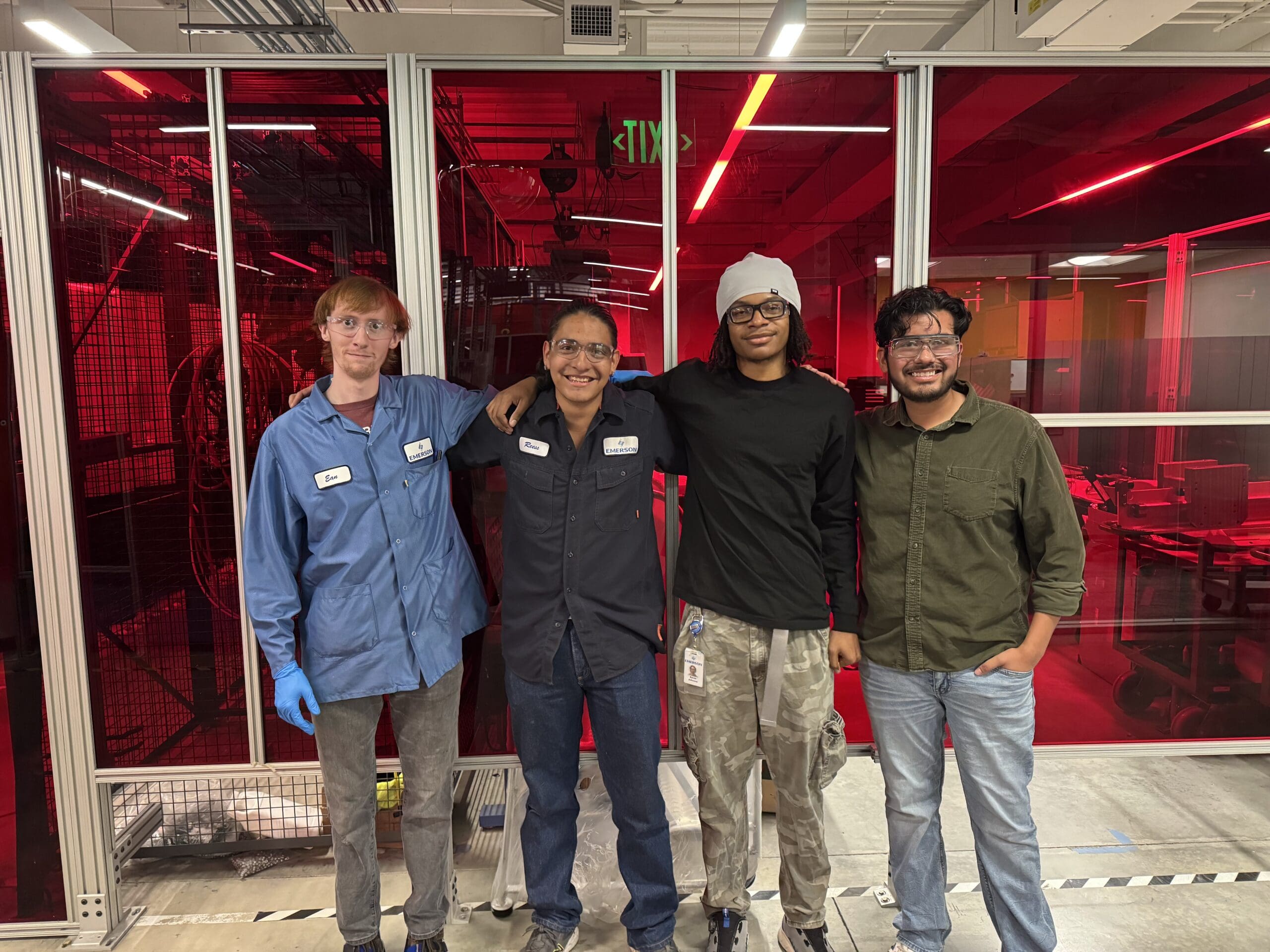
For decades, the message to high school graduates has been remarkably consistent: go to college, earn a degree, then start your career. But at Emerson’s Colorado operations, a growing group of supervisors and young professionals is proving there’s another path—one where learning and earning happen at the same time, and where a career can begin the day after graduation.
Through its apprenticeship program, Emerson is welcoming young people into roles across maintenance, manufacturing, and even human resources, pairing them with experienced mentors and giving them real responsibility from the start. The results, according to the people living it, speak for themselves.
A Different Kind of Classroom
For many apprentices, the hardest part isn’t the technical work—it’s the transition itself. “Moving from school to a full-time work environment is a culture shock—what works in school doesn’t work here,” says Scott Tipton, a supervisor who has mentored apprentices through the program. That adjustment period is real, and Emerson’s teams have learned to plan for it. As Tipton points out, “Even experienced technicians take time to understand everything on the floor.”
Reess Gutierrez, one of the program’s apprentices, remembers that early uncertainty well. “I didn’t know much about maintenance when I started—I was nervous coming in,” he admits. “The shift from school to work life was a huge step.” He was even surprised by the program’s structure: “I expected to go straight into work, so the classroom portion was a shock.”
But something changes a few months in. Tipton has watched it happen: “He really started to hit his stride around month four or five.” For Gutierrez, that stride showed up in efficiency and confidence. “Once I figured things out, I started finding faster ways to get the work done,” he says. “Some of those 30-minute tasks can be done in seven minutes if you know what you’re doing.”
Why Employers Are All In
Talk to the supervisors involved in Emerson’s apprenticeship program, and a theme emerges quickly: apprentices quickly become important members of the team; they’re an asset that often outperforms expectations.
Joshua Taylor, who supervises apprentices, has seen the advantage firsthand. “Apprentices come in without preconceptions, which makes them easier to train and more effective long term,” he says. In fact, one of his apprentices “picked up most of the processes faster than people we’ve brought in without a structured program.” And the assumption that young workers need constant oversight? “We expected we’d need to invest a lot more time in day-to-day supervision—but that hasn’t been the case at all,” Taylor notes. “You set them on the right path, check in, and they manage themselves.”
Tipton sees this as a benefit as well: “They come in without preconceived notions, which allows us to train them on our processes from the start.”
David Parker, another program leader, sees apprenticeships as essential infrastructure for the industry’s future. “This program is an absolutely required bridge for people entering trades and manufacturing,” he says. In his experience, the apprentices arrive ready: “They come in with a workable level of maturity—they’re trainable, attentive, and punctual.” The mentorship focus goes beyond technical skills, too. “We spend more time focusing on foundational professional skills—showing up, communicating, being reliable.”
There’s an unexpected bonus as well. Both Parker and Taylor note that apprentices sharpen the whole operation. “Apprentices bring a fresh set of eyes from outside—they look at things differently,” Parker says. Taylor puts it this way: “They bring a fresh set of eyes and ask questions that show where our processes need improvement.”
Not Just the Shop Floor
Emerson’s apprenticeship experience isn’t limited to the trades. Kate Gray, a first-time apprentice supervisor, mentors Salvador Hernandez—and she sees clear advantages to the apprenticeship model itself. “An apprenticeship role is unique in that it offers a longer period of time together,” she says. “This allows for work on larger initiatives that may span beyond a summer or set period of time.”
Gray is candid that mentorship came with an early learning curve. “Being clear on goals was the most important learning for me,” she reflects. “Once we had that clarity, everything worked smoothly.” What impressed her most was how quickly Salvador took ownership. “Salvador is incredibly smart and independent in his work. He can take a project and run with it, with minimal back and forth. Once he understands the goals, timing, and deliverables, he leverages his skills, internal network, and resources to complete the task. As a manager, this is incredibly valuable.”
Hernandez, for his part, made a deliberate choice. “I chose this path because I wanted to start my career right away instead of spending four more years in a classroom,” he says. That decision has come with real responsibility: “I have been trusted with real responsibilities, like supporting HR processes and answering employee questions, which makes the work feel meaningful.” It has also pushed him to grow in ways he didn’t expect. “Public speaking was something I was not comfortable with before, but now I am helping lead onboarding presentations.”
For Gray, the most rewarding part has been watching that growth translate into a specialized skill. “Watching Salvador grow his video skills has been greatly rewarding—now people ask to work with him specifically if they are working on a new social media video!”
Getting Paid to Build a Future
Perhaps the most compelling argument for apprenticeship is the simplest one. As Parker frames it, “You’re essentially being paid to learn skills that other people pay for.”
Ean Nieto, who joined the program straight out of high school, chose it deliberately over a traditional degree. “I chose the apprenticeship route instead of going to college,” he says. Now well into the program, he barely feels like a trainee: “I feel like I’m about 90% an employee and 10% still in the program.” Just as important, he feels heard. “It’s been a really positive change—I can bring things up and not feel pushed aside.”
And the financial case is strong. “You can make a high salary in this field without a four-year degree,” Tipton notes. Taylor jokes about what an earlier start would have meant for him: “If I had started at 19, I’d probably be retired by now.”
Even for apprentices who eventually move on, the value holds. “Even if you don’t stay, you leave with two years of experience and a real work ethic,” Neto says.
A Doorway to a Bigger Life
Emerson plans to keep the momentum going—Tipton says his team intends “to always have two apprentices—one starting and one midway through.” For students weighing their options, the advice from those inside the program is unanimous: look closer.
“I would tell other students to explore every option, because apprenticeships give you a real chance to learn and grow while working,” Hernandez says. Parker wishes the opportunity had existed for him: “If I had this opportunity, it would have changed my career trajectory completely.”
Nieto may sum it up best: “It’s a doorway to a bigger life that a lot of people don’t know exists.”